

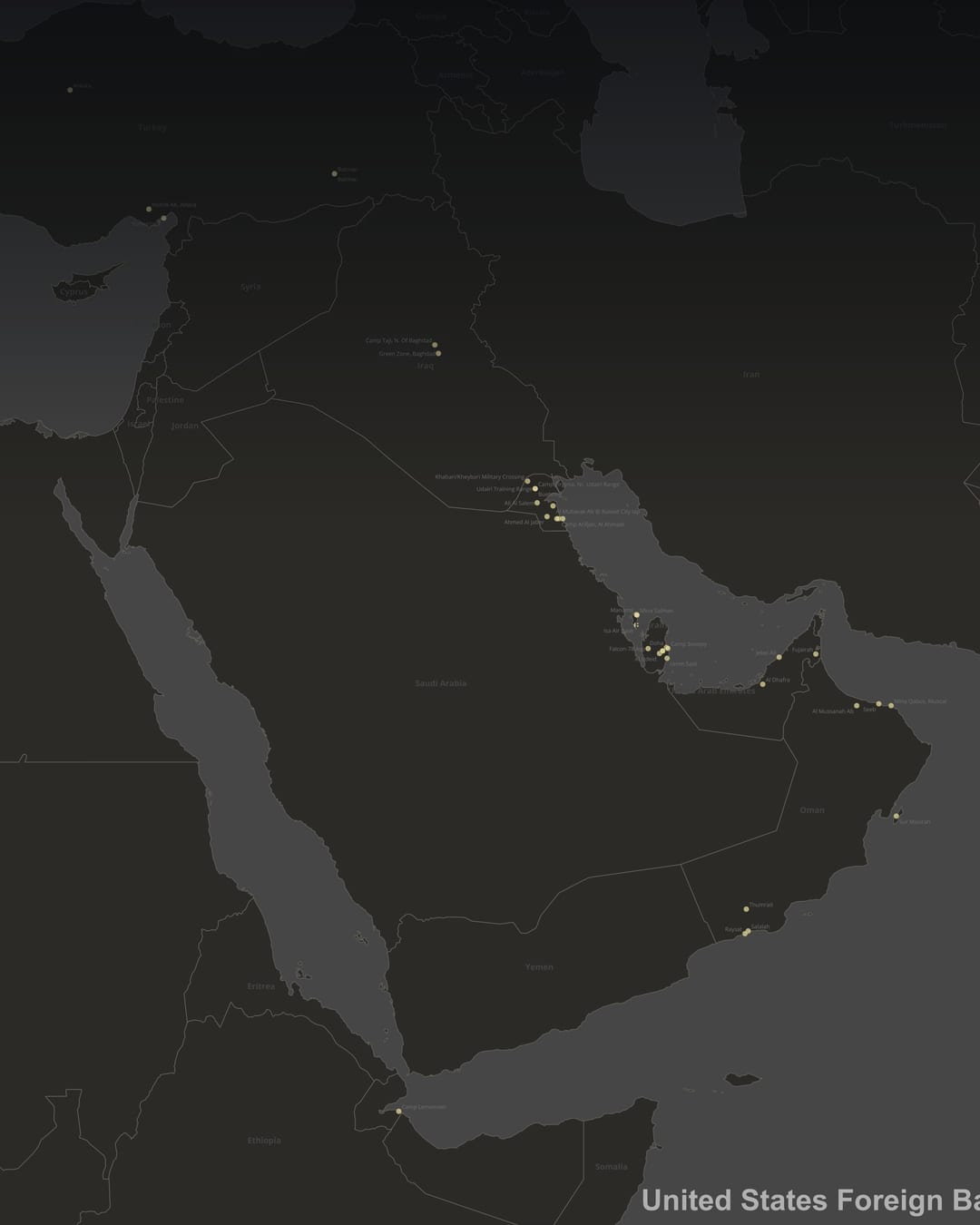
 Image: Wikimedia Commons. Regional U.S. military presence map used as conflict context.
- Kuwait's army said Thursday that air defenses were confronting hostile missile and drone attacks, with explosion sounds linked to interceptions.
- Kuwait's military did not immediately provide target details in the initial public announcement.
- No group immediately claimed responsibility, so the strongest public wording is attack reported by Kuwait, not confirmed attribution.
Kuwait's army says its air defenses are confronting hostile missile and drone attacks Thursday, adding another rupture to an already fragile Iran-war ceasefire.
The Associated Press reported that Kuwait's military made the announcement without immediately saying what had been targeted. That matters. In the first minutes of a regional attack report, the difference between "Kuwait says it faced an attack" and "Iran launched the attack" is not cosmetic. It is the line between verified reporting and premature attribution.
What happened
The Kuwait Army's official X account said Kuwaiti air defenses were confronting hostile missile and drone attacks and that explosion sounds were the result of air defense systems intercepting those attacks. AP's initial report says Kuwait announced the attack on Thursday, May 28, as the ceasefire around the Iran conflict again came under pressure. The report did not include confirmed impact locations, damage assessments, casualty figures or an official perpetrator claim.
Kuwait has been hit before during the conflict, including by Iranian fire and attacks attributed to Iran-backed Shiite militias in Iraq. That history makes Iran or aligned groups an obvious line of inquiry. It does not, by itself, make attribution settled for this incident.
Why the timing matters
The report landed after U.S. officials said American forces had again struck Iran during the ceasefire. AP separately reported that U.S. forces shot down four Iranian one-way attack drones near the Strait of Hormuz and struck an Iranian ground-control station in Bandar Abbas that officials said was about to launch another drone.
That sequence points to a ceasefire that is still formally discussed but operationally unstable. Diplomats may be negotiating an extension or a war-ending framework, while military forces continue to treat launches, drones, naval threats and ground-control systems as live threats.
 Image: Wikimedia Commons. Iranian flag and Azadi Tower in Tehran, used as Iran-war context.
What is confirmed and what is not
Confirmed: Kuwait's army says missiles and drones were involved and that air defense systems were intercepting hostile attacks. Confirmed: the announcement came during renewed U.S.-Iran military activity and stalled ceasefire diplomacy. Confirmed: no immediate responsibility claim was reported in the first AP dispatch.
Not confirmed in the initial public record: the exact target, whether every projectile was intercepted, whether there were casualties, and who ordered or launched the attack.
For readers seeing posts saying "Iran launched missiles and drones at Kuwait," the cautious version is better: Kuwait reported a missile and drone attack; Iran or Iran-aligned groups are plausible given the conflict context, but attribution was not immediately confirmed.
Why it matters
Kuwait is not just another regional bystander. It hosts U.S. military assets, sits inside the Gulf security architecture, and has already been exposed to spillover from the Iran war. Any renewed attack on Kuwaiti airspace risks pulling ceasefire talks away from diplomacy and back toward force protection.
The next signals to watch are Kuwait's defense ministry updates, any debris or interception claims, casualty reports, an Iranian or militia denial/claim, and whether Washington treats the event as a direct Iranian action or a proxy-linked attack.
NoDechev rating: confirmed official military statement, unconfirmed attribution. Kuwait's army says air defenses confronted hostile missile and drone attacks; early public reporting does not yet justify a categorical perpetrator claim.
Ready social post
Kuwait's army says air defenses are confronting hostile missile and drone attacks. Important caveat: early reporting gives no target details and no immediate claim of responsibility, so attribution is not settled yet.
Read next: Iran-U.S. talks progress, but no deal is imminent