
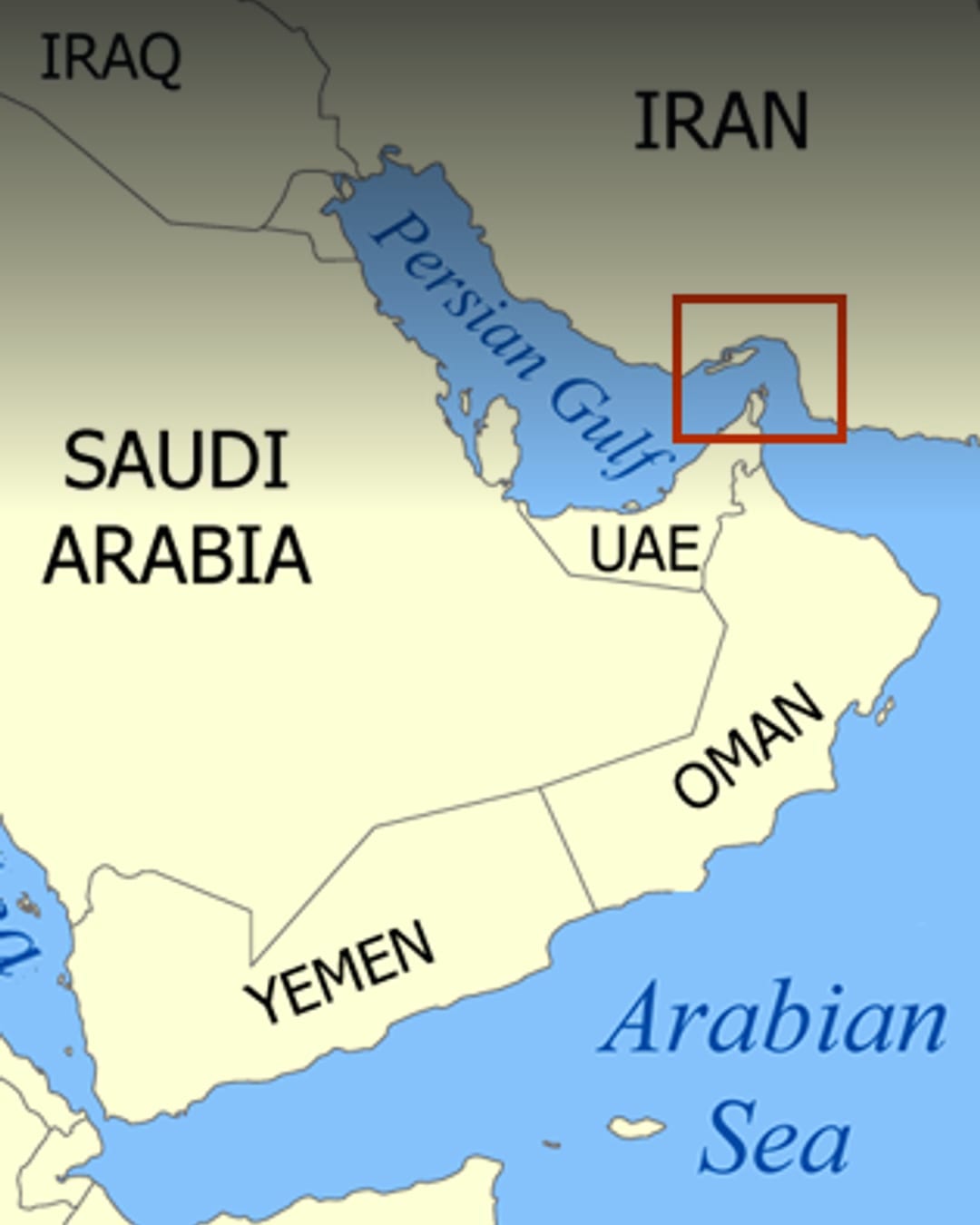
 Image: map of the Strait of Hormuz, showing the narrow waterway between Iran and Oman.
- The Strait of Hormuz links the Persian Gulf with the Gulf of Oman and the Arabian Sea.
- The U.S. Energy Information Administration calls it the world's most important oil transit chokepoint.
- Threats around Hormuz matter because oil, LNG, shipping, insurance and military escalation risk all move together.
The geography
The Strait of Hormuz is the narrow passage between Iran to the north and Oman and the United Arab Emirates side of the waterway to the south. It connects the Persian Gulf to the Gulf of Oman and then to the Arabian Sea. For Gulf producers, it is the main maritime exit to global markets.
The channel is narrow enough that security incidents can have outsized effects. A threat does not need to close the strait completely to matter. Even a partial disruption, higher insurance cost, rerouting fear or military alert can change pricing.
Why energy markets care
The U.S. Energy Information Administration describes Hormuz as the world's most important oil chokepoint. Large volumes of crude oil, condensate and petroleum products move through it from Gulf producers including Saudi Arabia, Iraq, Kuwait, the UAE, Qatar and Iran. Qatar also ships liquefied natural gas through the same broader route.
That concentration is why traders react fast to threats. Oil prices do not wait for a full blockade; they price risk. If market participants believe ships may be delayed, attacked, inspected, rerouted or insured at higher cost, the market moves before the full facts arrive.
Can the strait be closed?
In theory, a state or armed force could try to disrupt traffic with mines, missiles, drones, small boats, inspections or military pressure. In practice, closing Hormuz for long is difficult because it would hurt many states at once and invite a major international response.
That is why the realistic risk is often not a clean open-or-closed binary. The more common market problem is uncertainty: threats, attacks near shipping lanes, seizures, naval deployments and statements that raise the risk premium.
Why NoDechev links Hormuz explainers to breaking briefs
Many viral Hormuz claims skip the mechanics. They jump straight from a political quote to a dramatic market conclusion. A useful brief needs the middle steps: who said what, whether ships are actually delayed, what official maritime agencies report, what energy data shows, and whether the claim is about oil, LNG, military action or diplomacy.
That is also why Hormuz articles need clear sourcing. The same phrase can mean a threat, a policy position, a naval incident, an insurance signal or an actual disruption. Those are not interchangeable.
What to watch next
Watch official maritime advisories, U.S. Navy and regional military statements, tanker tracking, insurance commentary, EIA and IEA context, and whether Gulf producers issue operational updates. The strongest signal is not a viral map; it is a combination of official security warnings and observable shipping disruption.
The difference between threat and disruption
A Hormuz threat is not the same as a Hormuz closure. Officials, commanders and commentators often use the waterway as leverage because they know markets listen. A real disruption needs additional evidence: ship delays, maritime warnings, attacks, seizures, mine risk, naval deployments or insurance changes. Without those signals, a dramatic quote may be political pressure rather than operational reality.
That does not mean threats are harmless. Energy markets are forward-looking. If traders believe a threat raises the chance of future disruption, prices can move before tankers stop moving. The useful question is whether the claim changes actual transit risk or only adds political noise.
Why alternatives do not erase the risk
Some Gulf producers have pipelines that can move part of their exports outside the strait. That helps, but it does not make Hormuz irrelevant. The volumes, destinations, product types and timing still matter. A partial reroute may reduce the damage from a crisis, but it does not replace the normal flow of maritime traffic through the chokepoint.
For readers, the practical rule is simple: treat Hormuz stories as energy-security stories, not only war stories. The same incident can affect oil prices, LNG supply, shipping insurance, naval posture and diplomacy at once.
NoDechev note: this is an evergreen explainer, not a breaking-news claim. It is designed to give readers the background needed to read fast-moving briefs more carefully.
Use this as context
When a fast claim uses this term, start here, then check the linked brief and its source trail.
Read latest briefs →