
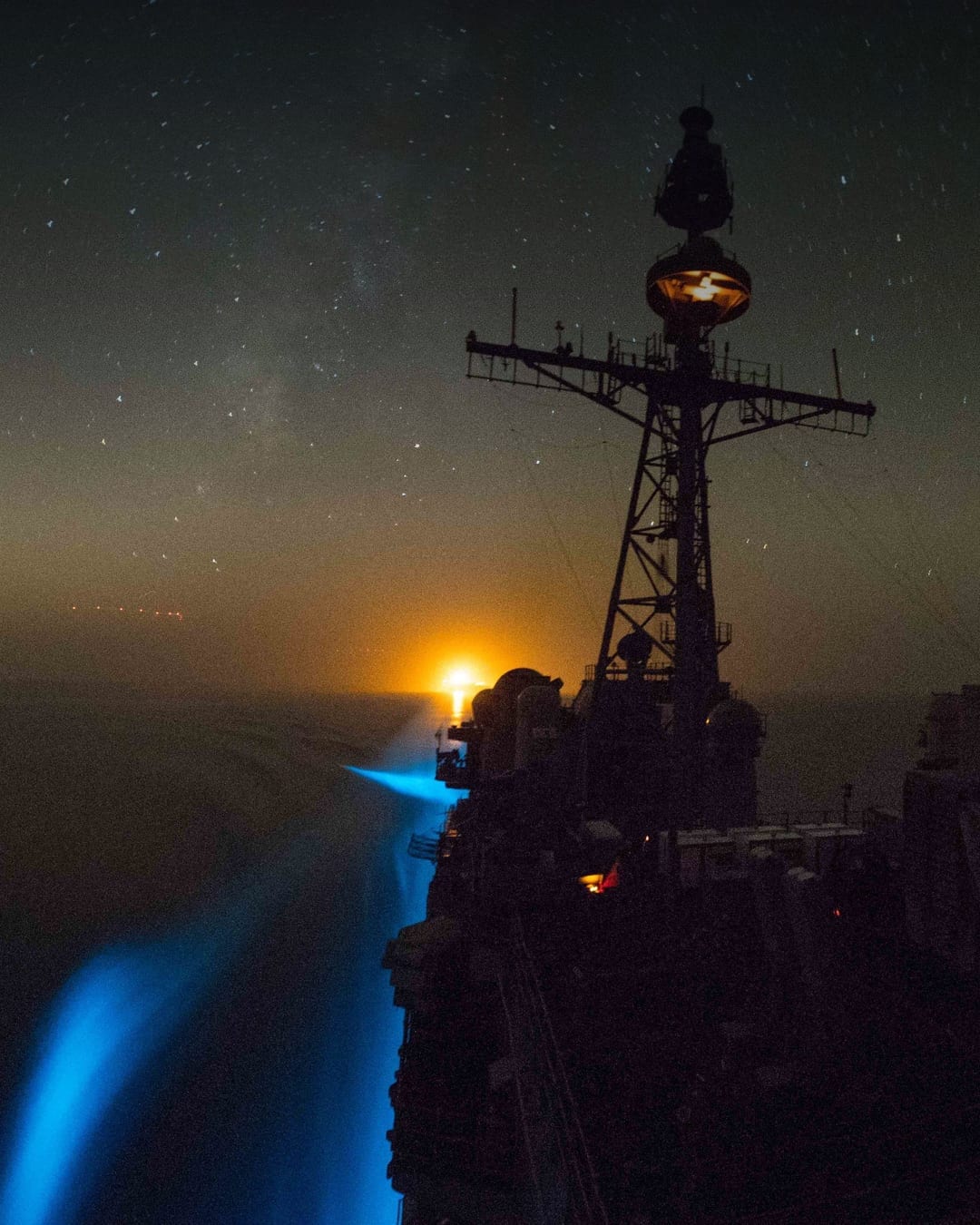
 Image: Gulf maritime security context. IRGC-linked stories often involve regional forces, shipping and drone or missile claims.
- The Islamic Revolutionary Guard Corps was created after Iran's 1979 revolution to protect the revolutionary system.
- It has land, naval, aerospace and external operations roles, separate from Iran's regular armed forces.
- IRGC-linked claims require careful sourcing because the institution is involved in politics, sanctions, regional networks, missiles, drones and maritime incidents.
The short version
The Islamic Revolutionary Guard Corps, often shortened to IRGC, is one of the most powerful institutions in Iran. It was created after the 1979 revolution to protect the Islamic Republic and the revolutionary system, not only to function as a conventional military force.
Today, the IRGC operates alongside Iran's regular military, known as the Artesh. The IRGC has its own ground, naval and aerospace arms, and it is often linked to missile, drone, regional proxy and maritime-security stories.
Why it is different from a normal army
A regular army usually exists to defend the state against external threats. The IRGC has that role too, but it also has ideological, political and internal-security significance. It is tied to the preservation of the Islamic Republic and has influence across security, politics and parts of the economy.
That structure makes IRGC headlines complicated. A statement from an IRGC commander can be a military signal, a domestic political signal, deterrence messaging, or part of information pressure during a crisis.
The Quds Force and regional networks
One of the best-known parts of the IRGC is the Quds Force, which is associated with external operations and relationships with regional armed groups. Western governments and analysts often link the Quds Force to Iran's regional strategy in Iraq, Syria, Lebanon, Yemen and elsewhere.
That does not mean every claim involving an Iranian-aligned group is automatically a direct IRGC order. A careful article should distinguish between alignment, support, public praise, operational control and verified responsibility.
Sanctions and terrorist designation
The United States has sanctioned the IRGC through multiple legal authorities and designated it as a Foreign Terrorist Organization in 2019. The European Union and other governments have also sanctioned IRGC-linked people and entities, though legal categories vary by jurisdiction.
This matters for readers because sanctions language can be confusing. A person, unit, company, vessel or financial network may be sanctioned without every related claim being proven. The legal designation is one source layer; the specific event still needs evidence.
Why NoDechev treats IRGC claims carefully
IRGC stories often combine military risk, propaganda, sanctions, regional politics and social-media exaggeration. A viral post may say the IRGC closed Hormuz, launched a strike, seized a ship, moved missiles or ordered a proxy attack. Each of those claims needs a source trail.
The strongest record usually comes from official statements, maritime agencies, U.S. or regional military statements, satellite imagery, credible wire reporting and direct evidence. The weakest record is a screenshot with no origin.
Why maritime stories often mention the IRGC
The IRGC Navy is especially relevant in Gulf stories because it operates in and around waters where U.S., Gulf, Iranian and commercial interests overlap. Incidents involving tankers, patrol boats, drones, missiles or the Strait of Hormuz often get framed through the IRGC because the organization is central to Iran's asymmetric maritime posture.
That does not mean every maritime incident is automatically an IRGC action. Some stories involve Iran's regular navy, local authorities, allied groups, or unclear attribution. A reliable brief should identify which institution is actually named in the source and whether the evidence comes from Iran, the United States, a shipping body, a regional government or independent reporting.
How to read IRGC statements
IRGC statements can be operational, political and deterrent at the same time. A commander may be speaking to foreign adversaries, domestic audiences and regional partners in one message. Strong language should therefore be quoted accurately without assuming that every threat is an immediate operational order.
The clean reading is source-first: who spoke, in what capacity, through which outlet, after what event, and whether any observable action followed. That keeps a reader from treating rhetoric, propaganda and verified military movement as the same thing.
NoDechev note: this is an evergreen explainer, not a breaking-news claim. It is designed to give readers the background needed to read fast-moving briefs more carefully.
Use this as context
When a fast claim uses this term, start here, then check the linked brief and its source trail.
Read latest briefs →