

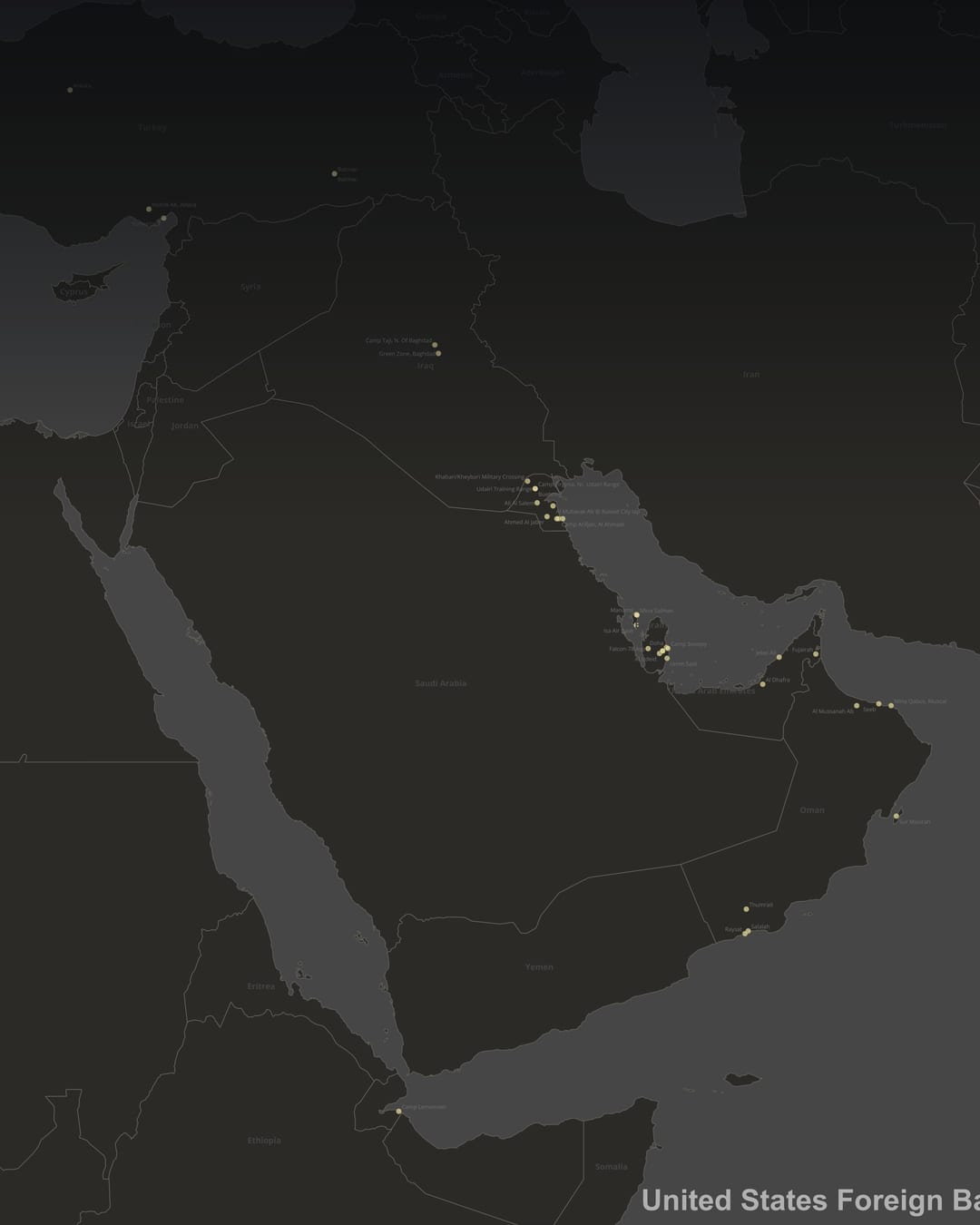
 Image: U.S. military presence map in the Middle East - Wikimedia Commons.
- The UAE condemned Iranian attacks on Bahrain, Kuwait and Jordan, calling the strikes terrorist attacks and a violation of sovereignty.
- The National and the Guardian reported that Iran targeted U.S.-linked sites in Bahrain, Kuwait and Jordan after U.S. strikes on Iran.
- The key verification boundary remains damage: launches and interceptions are reported, but successful damage claims still need official confirmation.
The UAE has moved the latest Iran retaliation into diplomatic language: terrorist attacks, sovereignty violations, and full solidarity with the targeted states.
That matters because the attacks were not only aimed at military geography. Bahrain, Kuwait and Jordan are states with their own governments, airspace, civilian infrastructure and escalation risk. When Iran fires at U.S.-linked targets inside those countries, the story becomes bigger than Washington and Tehran.
What happened
The latest round followed U.S. strikes on Iranian targets after the downing of a U.S. Army Apache near the Strait of Hormuz. Iran's Islamic Revolutionary Guard Corps then said it targeted U.S. forces in Bahrain, Kuwait and Jordan, according to regional and international live reporting.
The National reported that Kuwait, Bahrain and Jordan were attacked hours after the U.S. strikes, and that Iranian media said the IRGC hit U.S. forces in Bahrain and Jordan in retaliation. The Guardian's live coverage likewise reported that the IRGC said it had targeted an airbase in Jordan hosting U.S. forces, as well as Kuwait and Bahrain.
The UAE response is the diplomatic layer on top of that military exchange. Abu Dhabi framed the attacks as terrorist missile and drone attacks, expressed solidarity with Bahrain, Kuwait and Jordan, and backed measures those states take to protect security and stability.
Why the wording matters
Calling the strikes terrorist attacks is not neutral phrasing. It puts the UAE on the side of the targeted Gulf and Arab states, rejects Iran's retaliation framing, and treats the attacks as violations of state sovereignty rather than only an exchange with U.S. forces.
That distinction is important for readers. Iran can describe its launches as retaliation for U.S. strikes. The UAE and other regional governments are saying the same launches crossed sovereign red lines because they were fired into or toward countries that are not just empty military platforms.
 Image: Naval Support Activity Bahrain installation services complex - U.S. Navy/Wikimedia Commons.
What is confirmed
Confirmed by public reporting: Iran said it targeted U.S.-linked sites in Bahrain, Kuwait and Jordan after U.S. strikes on Iran. Confirmed: the UAE and other regional actors condemned Iranian attacks and described them as violations of sovereignty and international law.
Also confirmed: Bahrain and Kuwait have already been part of the same escalation pattern. Earlier reporting said missiles and drones were fired toward those countries, with interceptions reported and U.S. damage claims disputed by CENTCOM in at least the Bahrain case.
What is not confirmed
Not confirmed from the public record: that every Iranian claim about damage or target success is accurate. In the Bahrain case, CENTCOM has publicly disputed Iranian claims of damage to U.S. Fifth Fleet headquarters and said there were no reports of harm to U.S. personnel in the earlier exchange.
So the clean read is this: the attacks and condemnations are real. The full battle-damage picture is still not settled in public sources.
Why it matters
The UAE statement shows how fast a U.S.-Iran exchange can become a regional sovereignty crisis. Bahrain hosts U.S. naval infrastructure. Kuwait hosts U.S. military forces. Jordan has long been a key U.S. security partner. Strikes toward those places test not only U.S. deterrence, but the regional host-state system around it.
The danger is not just one missile or drone getting through. It is the diplomatic chain reaction: states condemn, air defenses stay on alert, Iran says it is retaliating, Washington says it is responding, and every host country becomes part of the pressure map whether it wants that role or not.
What to watch next
Watch for official statements from Bahrain, Kuwait and Jordan on interceptions, debris, casualties or airspace restrictions. Also watch CENTCOM for any full battle-damage assessment, and the UAE foreign ministry for whether the condemnation becomes part of a broader GCC diplomatic track.
NoDechev rating: UAE condemnation confirmed by regional source trail; Iranian launches toward Bahrain, Kuwait and Jordan are widely reported; successful damage claims remain separately unverified.
Ready social post
UAE says it strongly condemns Iran's attacks on Bahrain, Kuwait and Jordan as terrorist attacks. The key context: launches and regional condemnations are confirmed; the full damage picture still needs official proof.
Read next: Bahrain damage claims, checked