

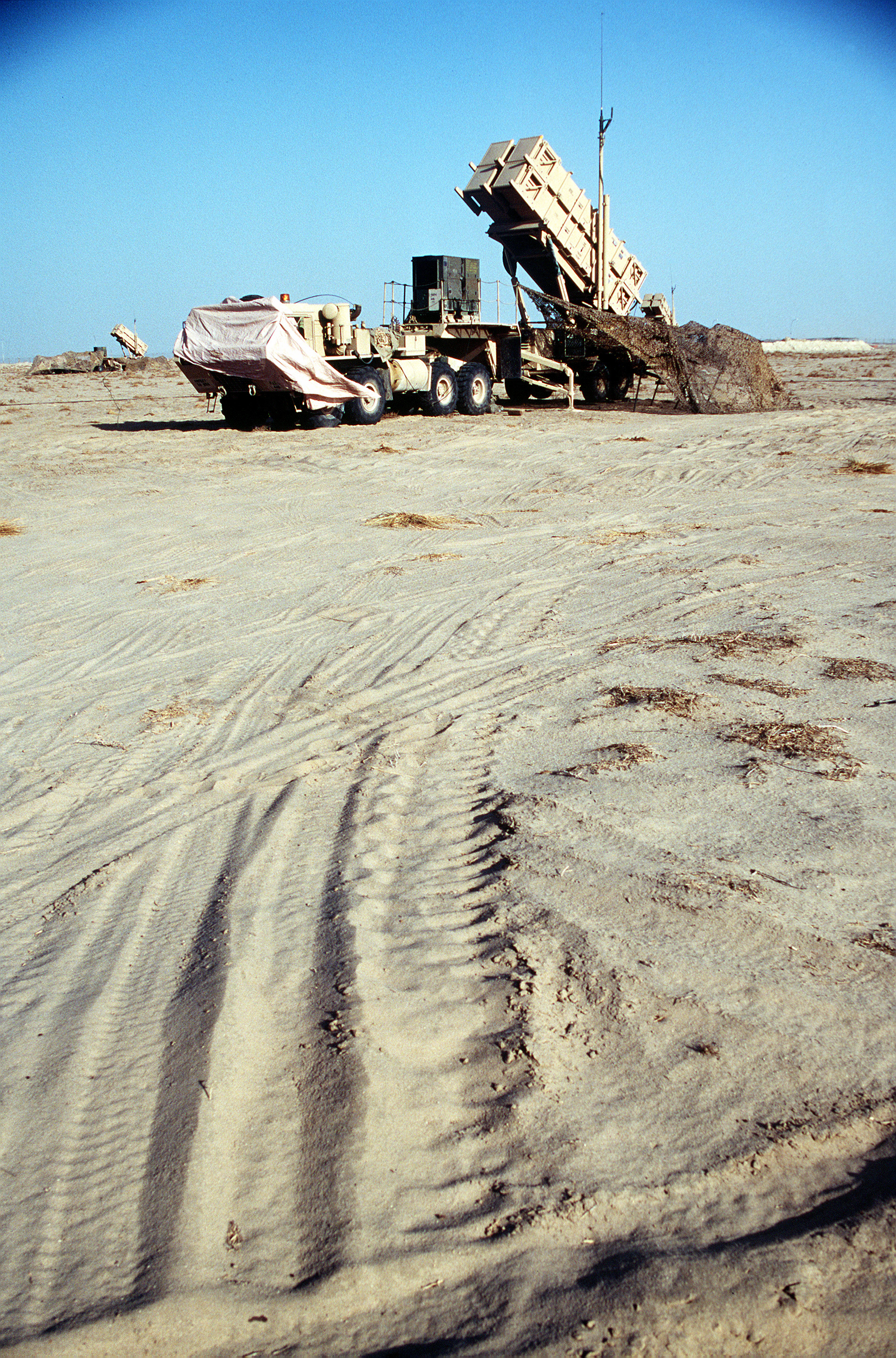
 Image: U.S. Army Patriot missile launcher near Camp Doha, Kuwait - U.S. Army / public domain.
- AP reported that CENTCOM said U.S. forces shot down two Iranian ballistic missiles launched toward bases housing American troops in Kuwait.
- CENTCOM said no American forces were hurt, according to the AP report.
- The attack followed U.S. self-defense strikes on Iranian radar and drone-control sites around Goruk and Qeshm Island.
U.S. forces shot down two Iranian ballistic missiles launched toward bases that house American troops in Kuwait, according to an Associated Press report citing U.S. Central Command.
The report says no American service members were hurt. That detail matters because Kuwait has already been one of the most sensitive pressure points in the wider U.S.-Iran conflict: it hosts U.S. Army Central, sits close to Iran's missile range, and has repeatedly appeared in official accounts of missile and drone interceptions during the ceasefire period.
What happened
AP reported Monday that Iran said it targeted American soldiers in Kuwait after the United States bombed military sites in Iran. The same report said CENTCOM stated that U.S. forces downed two ballistic missiles Iran launched toward bases where American troops are stationed.
Kuwait had earlier said its air defenses opened fire to intercept incoming drone and missile fire. Iran's Islamic Revolutionary Guard Corps acknowledged a retaliatory attack, though its public wording did not give the same operational detail as the U.S. account.
The cleanest confirmed version is narrower than the viral framing: CENTCOM, as cited by AP, says two Iranian ballistic missiles were shot down and no U.S. personnel were injured. The public record does not yet establish every launch site, every intended base, or the exact interception system used.
Why it happened now
The missile fire came after CENTCOM said U.S. forces carried out self-defense strikes on Iranian radar and drone command-and-control sites in Goruk and on Qeshm Island over the weekend. CENTCOM said those strikes followed aggressive Iranian actions, including the shootdown of a U.S. MQ-1 drone operating over international waters.
CENTCOM also said U.S. aircraft eliminated Iranian air defenses, a ground-control station and two one-way attack drones assessed as threats to ships moving through regional waters. That sequence turns the Kuwait missile fire into part of a broader exchange: Iran targets U.S.-linked positions, the U.S. hits Iranian military infrastructure, and Tehran answers again.
 Image: U.S. Central Command seal - U.S. Central Command.
What is confirmed
Confirmed: AP reported the two-missile interception claim from CENTCOM; Kuwait reported incoming drone and missile fire; Iran acknowledged a retaliatory strike; and CENTCOM separately confirmed U.S. self-defense strikes on Iranian military sites tied to radar and drone operations.
Also confirmed: CENTCOM has been publicly framing these incidents as ceasefire violations or responses to Iranian aggression. On May 28, the command said Iran launched a ballistic missile toward Kuwait that was intercepted by Kuwaiti forces and called that earlier launch an egregious ceasefire violation.
What is not confirmed
Not confirmed: that any American was injured in this latest two-missile incident. The public reporting says the opposite, attributing a no-injury statement to CENTCOM.
Also not confirmed: whether the latest launch changes the diplomatic track by itself. The U.S. and Iran have continued to trade accusations while still leaving room for talks, which is exactly why each new strike now carries more political weight than a single tactical incident would normally carry.
Why it matters
Kuwait is not just a nearby Gulf state in this story. It is a host country for U.S. military infrastructure and a practical test of whether the ceasefire can contain spillover attacks against American forces. A missile intercepted over or toward Kuwait raises the stakes without necessarily producing casualties.
The danger is cumulative. A no-casualty interception can still harden U.S. and Iranian positions, push regional air defenses into a higher alert cycle, and make the next diplomatic statement harder to sell at home. That is the logic behind the current pattern: each side says it is responding defensively, while the map of the conflict keeps widening.
What to watch next
Watch for a direct CENTCOM public release naming the Kuwait bases or the interception timeline. Also watch Kuwait's defense ministry for damage, debris or airspace updates, and Iranian state media for whether the strike is framed as a one-off retaliation or the start of a new pressure phase.
The clean read: the interception claim is sourced to CENTCOM through AP; the no-injury detail is important; and the bigger story is not only two missiles. It is that Kuwait remains one of the places where a fragile U.S.-Iran ceasefire can break in practice before it formally breaks on paper.
NoDechev rating: confirmed official claim, limited operational detail. CENTCOM's two-missile account is reported by AP; additional base-level and interception-system details remain unconfirmed in the public record.
Also Read
The Kuwait missile story fits into a wider ceasefire-verification problem: official claims move faster than independent proof.
Read the ceasefire verification explainer ->