

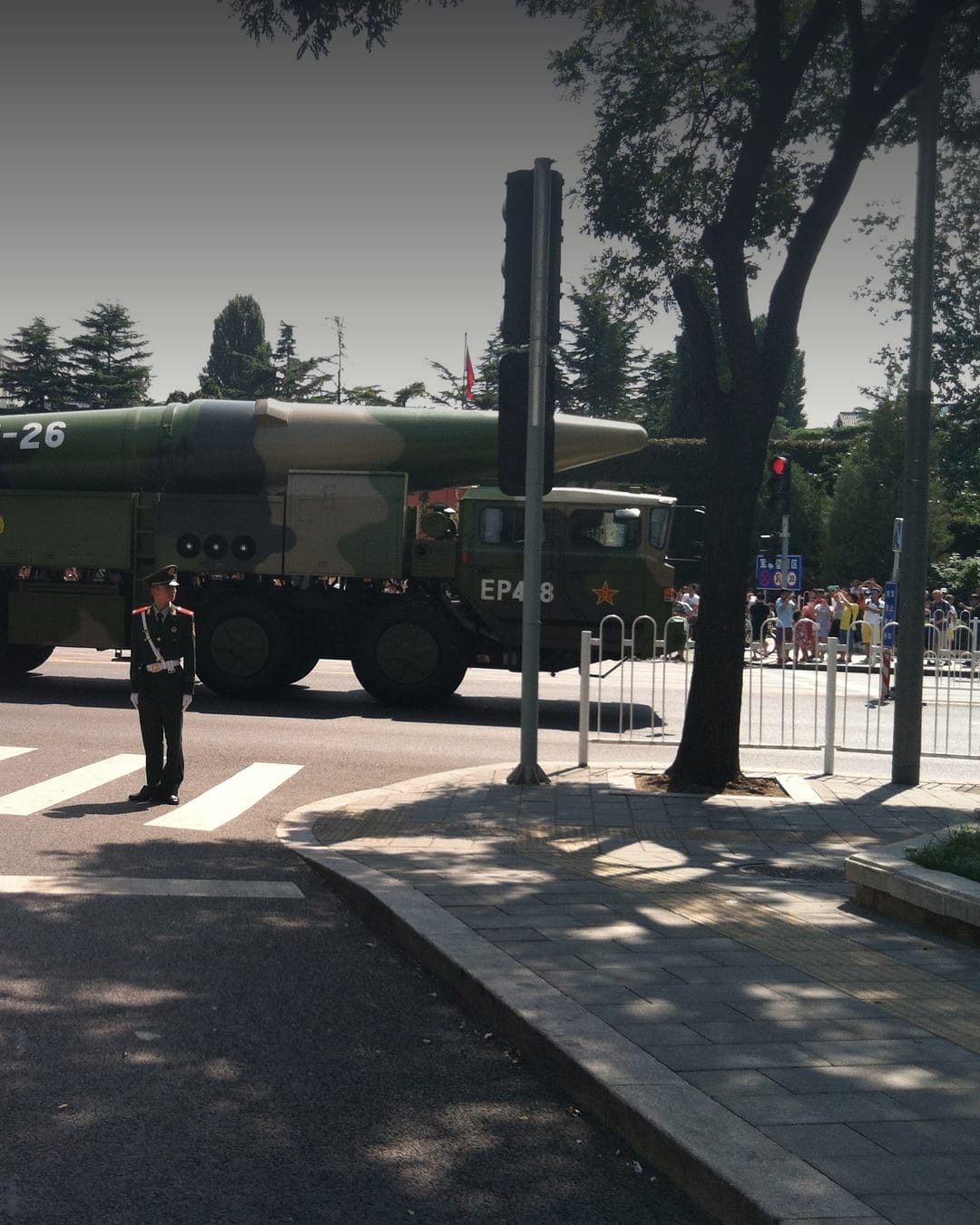
 Image: DF-26 ballistic missile launcher after China’s 2015 military parade - IceUnshattered / Wikimedia Commons, CC BY-SA 4.0.
- Reuters reported on May 29 that satellite images show China building more than 80 launch pads near nuclear missile silo fields.
- The pads appear connected to China’s broader missile modernization, after earlier public work identified large silo fields near Yumen, Hami and Ordos.
- The strongest public wording is still imagery-based: Reuters and independent analysts can identify infrastructure, but Beijing has not confirmed the full purpose of every site.
China is building a network of launch pads near its nuclear missile silos, according to a Reuters report based on satellite images published on May 29.
The headline finding is specific: more than 80 launch pads are visible near China’s newer silo fields. That matters because it suggests Beijing is not only relying on fixed underground silos. It may also be preparing nearby dispersed launch points that could support mobile missile operations, training, decoys, logistics or a more complex wartime posture.
What Reuters found
Reuters’ report, carried by MarketScreener, says the pads are being built near nuclear missile silos. The article itself is partially gated, so the public source trail should be read with care: the Reuters headline and timestamp are visible, while the detailed image-by-image analysis is not fully available through the open page.
Still, the claim fits a broader pattern that has been documented for years by open-source nuclear analysts. Federation of American Scientists researchers identified major Chinese silo-field construction near Yumen and Hami in 2021, including grid-like layouts, shelters over suspected silo headworks and support facilities across hundreds of square kilometers.
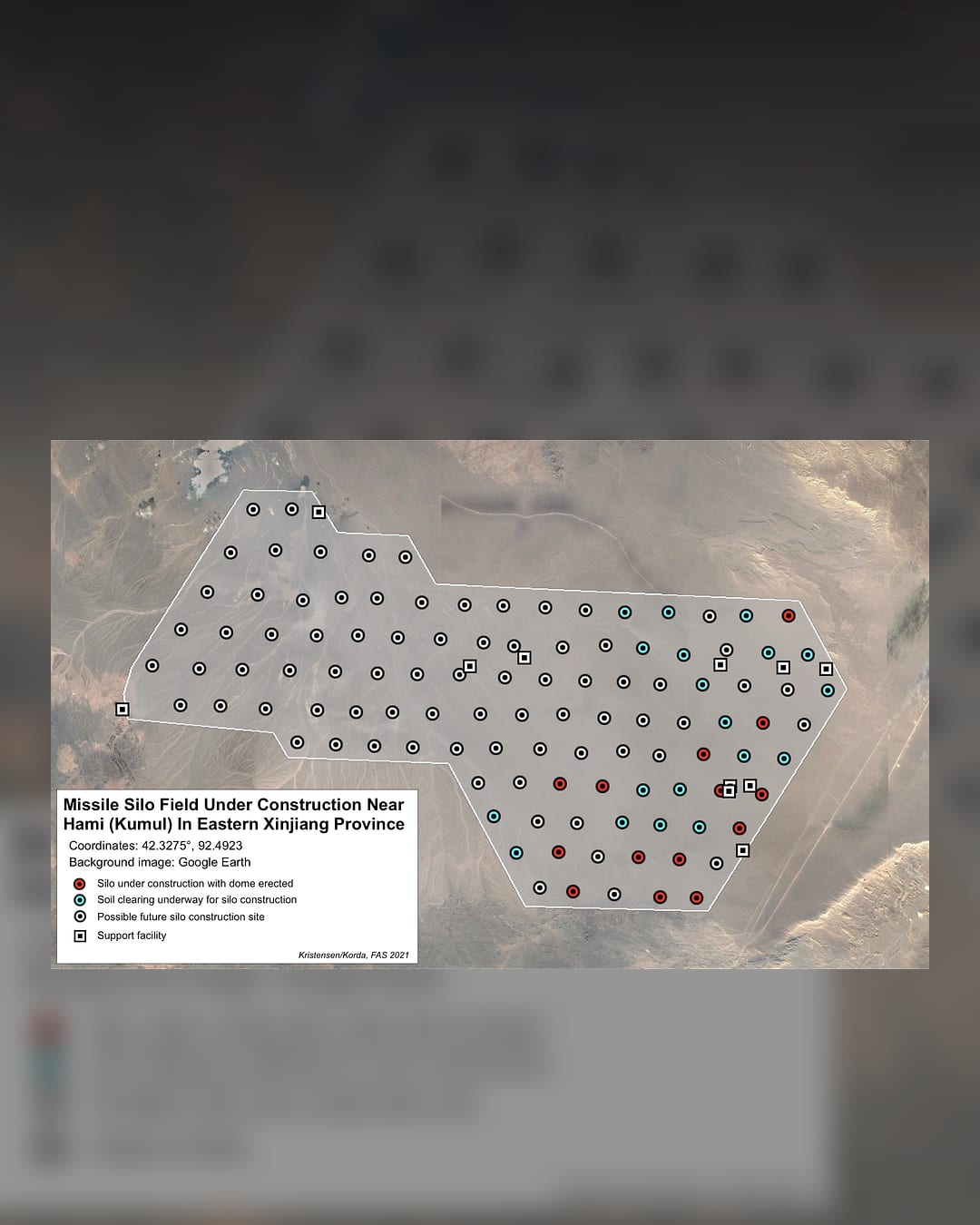 Image: FAS map of suspected Hami missile silo field construction, based on Google Earth imagery - Kristensen/Korda, Federation of American Scientists, 2021.
Why launch pads near silos matter
A silo is a fixed target. It can be hardened, hidden and defended, but its location eventually becomes known. Pads near a silo field change the geometry: they can support mobile launchers that move, disperse, rehearse or complicate an adversary’s targeting problem.
That does not automatically mean every pad holds a missile or that every structure has the same purpose. In missile-base analysis, similar-looking concrete pads can be used for launch drills, support vehicles, command equipment, transporter-erector-launcher positioning or decoys. The point is not that Reuters has found 80 new missiles. The point is that the infrastructure gives China more options around the missile fields.
The bigger nuclear picture
China’s nuclear force has been expanding from a historically smaller “minimum deterrence” posture toward a larger and more survivable force. FAS estimated in 2021 that Yumen and Hami together could represent roughly 230 new silo positions, while warning that it was unclear how many would be filled, armed or used as decoys.
More recently, Reuters reported from a draft Pentagon assessment that China likely loaded more than 100 ICBMs across its latest three silo fields. Arms Control Association’s public nuclear-weapons fact sheet also cites the U.S. Defense Department assessment that China had a little more than 600 nuclear weapons as of late 2025 and could reach up to 1,000 deliverable warheads by 2030 if the current trajectory continues.
What is confirmed
Confirmed: Reuters has published the May 29 report; independent public-source work has documented large Chinese silo-field construction; U.S. and independent assessments agree China’s nuclear arsenal and delivery infrastructure are expanding.
Still inferential: the exact operational role of each new launch pad, whether all pads are active military launch positions, and how China would combine silos, road-mobile launchers and decoys in a crisis.
What to watch: whether additional commercial imagery shows road links, transporter shelters, fuel or command-support facilities, and whether U.S., Taiwanese, Japanese or allied intelligence assessments update their public language around China’s launch posture.
NoDechev rating: verified Reuters report, imagery-based assessment. The infrastructure story is credible and consistent with prior silo-field evidence, but claims about exact missile loading or doctrine should stay qualified unless official or higher-resolution evidence emerges.
Ready social post
Reuters says satellite images show China building 80+ launch pads near its nuclear missile silo fields. The signal is not “80 new nukes”; it is infrastructure for a more flexible and harder-to-target missile posture.
Read next: U.S. Navy Official Says Taiwan Arms Sales Are on Pause