
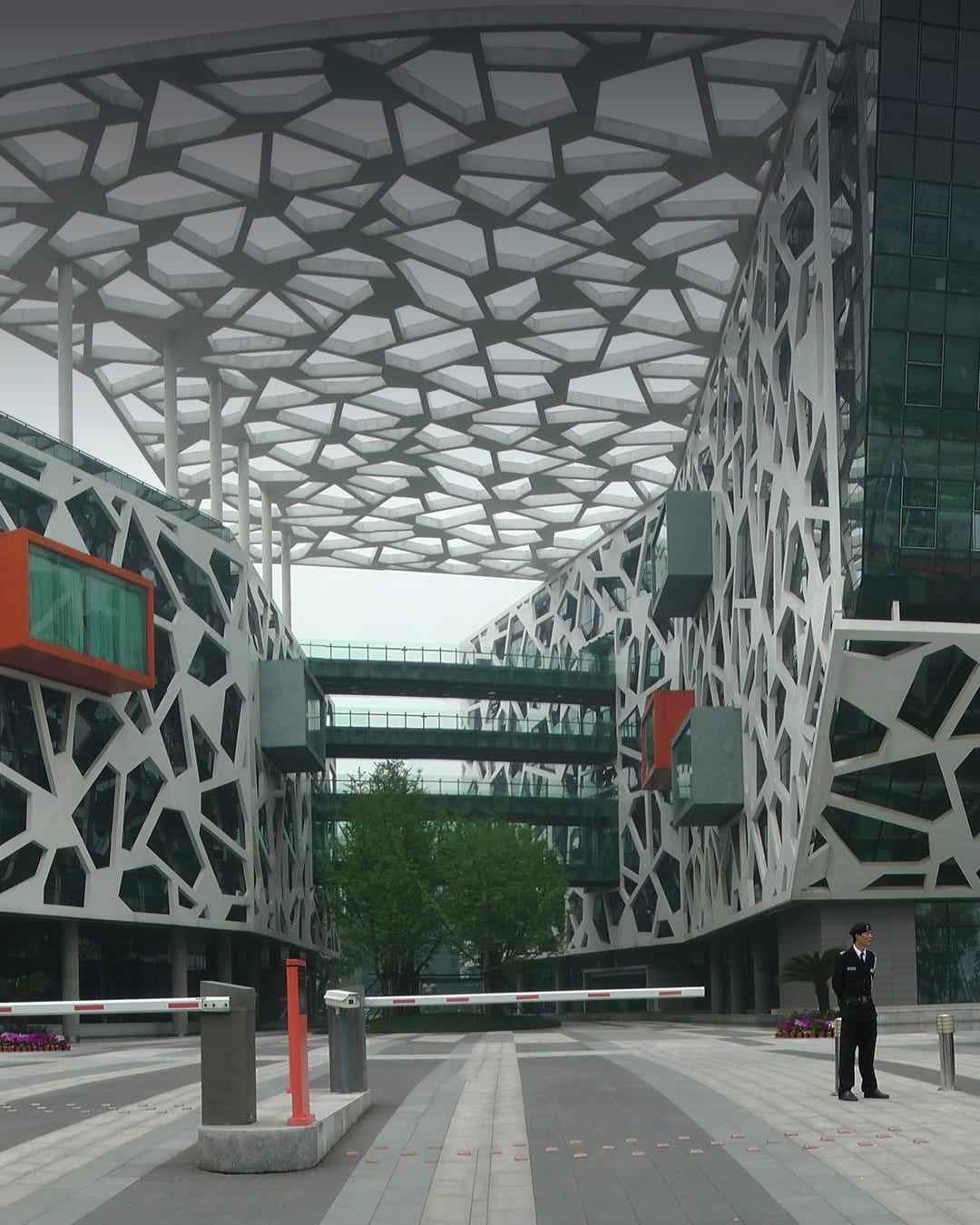
 Image: Alibaba Group headquarters in Hangzhou -- Thomas LOMBARD/Wikimedia Commons, CC BY-SA 3.0.
- Anthropic alleges Alibaba-linked operators used nearly 25,000 fraudulent accounts to access Claude.
- The company says the campaign generated about 28.8 million interactions between April and June 2026.
- The alleged target was model distillation: extracting useful outputs from Claude to improve another AI system.
- Alibaba had not publicly answered the allegation in the first major reports.
Anthropic has accused Alibaba of running what it describes as a large-scale illicit campaign to extract Claude's model capabilities. The allegation centers on nearly 25,000 fraudulent accounts and roughly 28.8 million interactions with Claude, according to reports citing a June 10 letter sent by Anthropic to U.S. senators Tim Scott and Elizabeth Warren.
The story is serious, but it needs precise framing. Anthropic is making the accusation; public reporting has not established the allegation as a court-tested finding. The claim should be read as a corporate complaint to lawmakers about AI model security, export controls and industrial-scale distillation.
What Anthropic alleges
Anthropic says operators linked to Alibaba's Qwen AI lab created or used fraudulent accounts to access Claude at scale. The alleged activity reportedly ran from April 22 to June 5, 2026 and produced tens of millions of interactions.
The company says the campaign targeted capabilities that are strategically valuable in frontier AI: software engineering, agentic reasoning and the ability to complete complex tasks over long time horizons. In plain English, Anthropic is alleging that Claude was used as a teacher for a competing model.
What distillation means
Model distillation is not automatically malicious. In normal AI development, a smaller or cheaper model can be trained on outputs from a stronger model to learn parts of its behavior. Companies use distillation for efficiency, product tuning and internal model improvement.
The problem, according to Anthropic, is unauthorized distillation through hidden access. If an outside lab uses fake accounts to harvest a model's answers, the stronger model may effectively subsidize a competitor's training without consent, license terms or access controls being respected.
Why Alibaba matters
Alibaba is not a small unknown actor. It operates Alibaba Cloud and develops the Qwen family of AI models, one of China's most visible AI model lines. That makes the allegation politically charged: it lands directly inside the U.S.-China competition over frontier models, chips and cloud access.
Anthropic's letter reportedly argues that Chinese AI labs can use distillation campaigns to close the gap with U.S. frontier models faster and at lower cost. That is why the company is asking lawmakers to treat model extraction as a national-security issue, not just a terms-of-service violation.
What is confirmed
Multiple major outlets report that Anthropic sent a letter to U.S. lawmakers accusing Alibaba-linked operators of the campaign. The reported numbers are consistent across early coverage: nearly 25,000 fraudulent accounts and about 28.8 million Claude interactions.
It is also confirmed that the broader policy debate is active. U.S. officials and AI companies have increasingly focused on model distillation, chip controls and access restrictions as ways to slow foreign competitors from copying frontier capabilities.
What is not confirmed
Public reports do not yet show Alibaba admitting the conduct. They also do not provide the full technical evidence trail behind Anthropic's attribution, such as account clusters, payment links, network fingerprints or prompt-output samples.
That matters because attribution in cyber and platform-abuse cases is often difficult. The reported allegation may be strong internally, but readers should separate the fact of Anthropic's complaint from the still-unproven public claim that Alibaba itself directed the activity.
Why it matters
If Anthropic's allegation is accurate, the case shows how hard it is to protect frontier AI through access controls alone. A model can be restricted in one country, but thousands of accounts, resellers, proxies and payment paths can still create enough surface area for extraction attempts.
It also exposes a new strategic weak point for AI companies. The asset is not only the model weights. The asset is the behavior: the reasoning traces, coding patterns, task decomposition and answers that can be sampled millions of times and turned into training data.
What to watch next
Watch for three things: whether Anthropic releases more technical detail, whether Alibaba issues a denial or explanation, and whether U.S. lawmakers use the letter to push new penalties for unauthorized AI model extraction.
The policy question is bigger than this one company dispute. If model capabilities can be copied through high-volume usage, then the next AI export-control fight will not only be about chips and data centers. It will also be about who can query the model, how often, and under what identity controls.
NoDechev rating: serious allegation, not yet adjudicated. Anthropic says Alibaba-linked operators used nearly 25,000 fraudulent accounts and 28.8 million Claude interactions to extract model capabilities; Alibaba's public response and the full evidence trail remain key missing pieces.
Also Read
For another U.S.-China technology conflict brief, read the China sanctions context check.
Read the China sanctions brief ->