
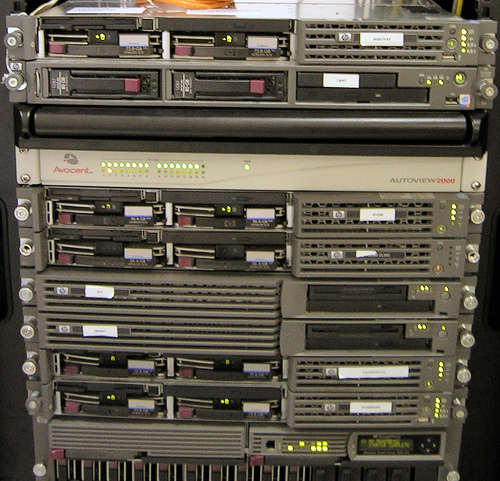
 Image: Computer server rack - ronK / Wikimedia Commons, CC BY-SA 2.5.
- An AI data center is a facility built to run high-density AI training and inference workloads, usually with GPUs or other accelerators.
- The bottleneck is not only chips. Power supply, cooling, networking, land, substations and permitting can decide whether a project gets built.
- Gigawatt-scale announcements should be read as infrastructure plans until sites, grid connections, customers and construction milestones are confirmed.
What an AI data center is
A data center is a building or campus that houses computing equipment: servers, storage, networking, power distribution, backup systems and cooling. An AI data center is designed around the much denser compute needed to train, fine-tune or serve artificial intelligence models.
The key difference is workload. A traditional enterprise data center might support business software, web hosting, storage and internal systems. An AI facility is built around accelerated computing, usually large clusters of GPUs or other AI chips that process enormous matrix operations in parallel. That makes the facility more power-dense and more sensitive to heat, latency and networking bottlenecks.
Training vs inference
AI infrastructure is often split into training and inference. Training is the phase where a model learns patterns from large datasets. It is usually compute-heavy, time-sensitive and run on tightly connected clusters. Inference is the phase where a trained model answers users, summarizes documents, generates images, writes code or powers search and recommendation tools.
Both need data centers, but they stress the system differently. Training can require huge synchronized clusters for weeks or months. Inference can run continuously and must respond quickly to users. When AI companies announce new capacity, the missing detail is often whether the site is meant for training, inference, cloud resale, internal use or some mix of all four.
Why power is the central issue
AI data centers are often discussed in megawatts or gigawatts because electricity is the limiting input. The International Energy Agency says AI is accelerating the deployment of high-performance accelerated servers and increasing power density in data centers. It also notes that hyperscale AI centers can exceed 100 MW, far larger than many traditional facilities.
A gigawatt is 1,000 megawatts. So a 1 GW campus is not just a large computer room; it is a major power-system customer. A 5 GW announcement, like SoftBank's French AI infrastructure plan, should be read against the same reality: the project needs land, transmission, grid studies, substations, backup systems, equipment procurement and years of execution.
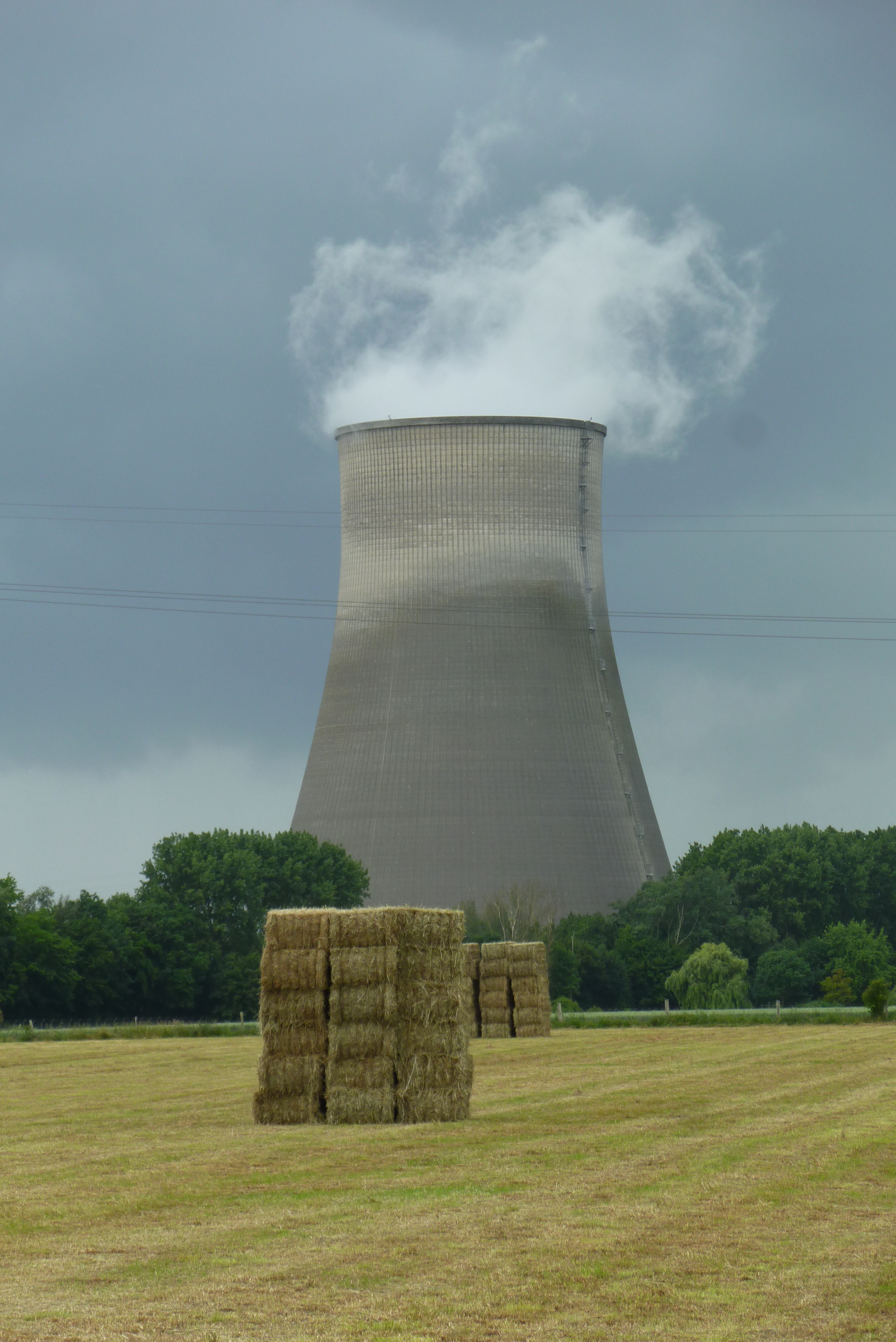 Image: Bouchain power station cooling tower in northern France - Grobert, Wikimedia Commons, CC BY-SA 3.0.
Cooling and PUE
Chips turn electricity into heat. Dense AI clusters can produce more heat per rack than ordinary server rooms, which is why liquid cooling, direct-to-chip systems and more complex airflow design are becoming more common. Cooling is not decorative infrastructure; it is part of whether the chips can run reliably.
One common efficiency metric is power usage effectiveness, or PUE. PUE compares total facility power with the power used by IT equipment. A lower PUE generally means less overhead for cooling, fans, pumps and power conversion. But PUE is not the whole story. A facility can have a good PUE and still create real grid, water, land or local-cost questions if its total load is large enough.
What is confirmed in an announcement
When a company says it will build an AI data center, the confirmed facts are usually narrow: the company, planned location, intended capacity, expected investment, named partners and target timeline. Those details matter, but they are not the same as operational capacity.
The stronger evidence comes later: land filings, grid-connection agreements, permits, construction starts, equipment orders, anchor customers, energization dates and disclosed workloads. A source-first reader should treat the press release as the first layer, then look for those later milestones.
What is often not confirmed
Many viral posts skip the caveats. They may say a company "built" or "opened" a data center when the public source only says "plans," "commitment," "memorandum" or "selection." They may also convert a maximum investment figure into a guaranteed spend, even when the project is phased and depends on regulatory and grid execution.
Customer claims can also be weak. A facility may be marketed for AI companies, cloud providers or government research without naming committed tenants. Until customers, contracts and operating dates are public, the safest language is planned capacity, proposed campus or announced investment.
Why it matters
AI data centers matter because they turn software competition into physical infrastructure competition. The next generation of AI depends on chips, but also on power supply, industrial land, fiber networks, cooling systems, transformers, electricians and local acceptance.
They also matter for readers because the headline numbers are easy to misunderstand. A multibillion-euro announcement can be real and still not be a finished facility. A gigawatt-scale capacity target can be strategically important and still face permitting or grid delays. The clean read separates ambition from delivery.
What to watch next
For any AI data center story, watch five signals: whether the site is identified, whether grid access is secured, whether construction begins, whether chips or cooling systems are ordered, and whether an anchor customer is named. Local government and environmental review are also part of the source trail, especially when projects affect water, land or household electricity costs.
For the SoftBank France plan, those same questions apply. The official announcement gives a serious starting point: up to 5 GW in France, a first phase of 3.1 GW in Hauts-de-France by 2031, and named locations including Dunkirk/Loon-Plage, Bosquel and Bouchain. The next layer is execution.
NoDechev note: AI data center claims should be read as infrastructure claims, not just tech headlines. Always separate announced capacity, financed capacity, built capacity and operating capacity.
Use this before reading AI infrastructure headlines
Start with the announced capacity, then ask what is already built, powered, permitted and contracted.
Read the SoftBank France brief ->