
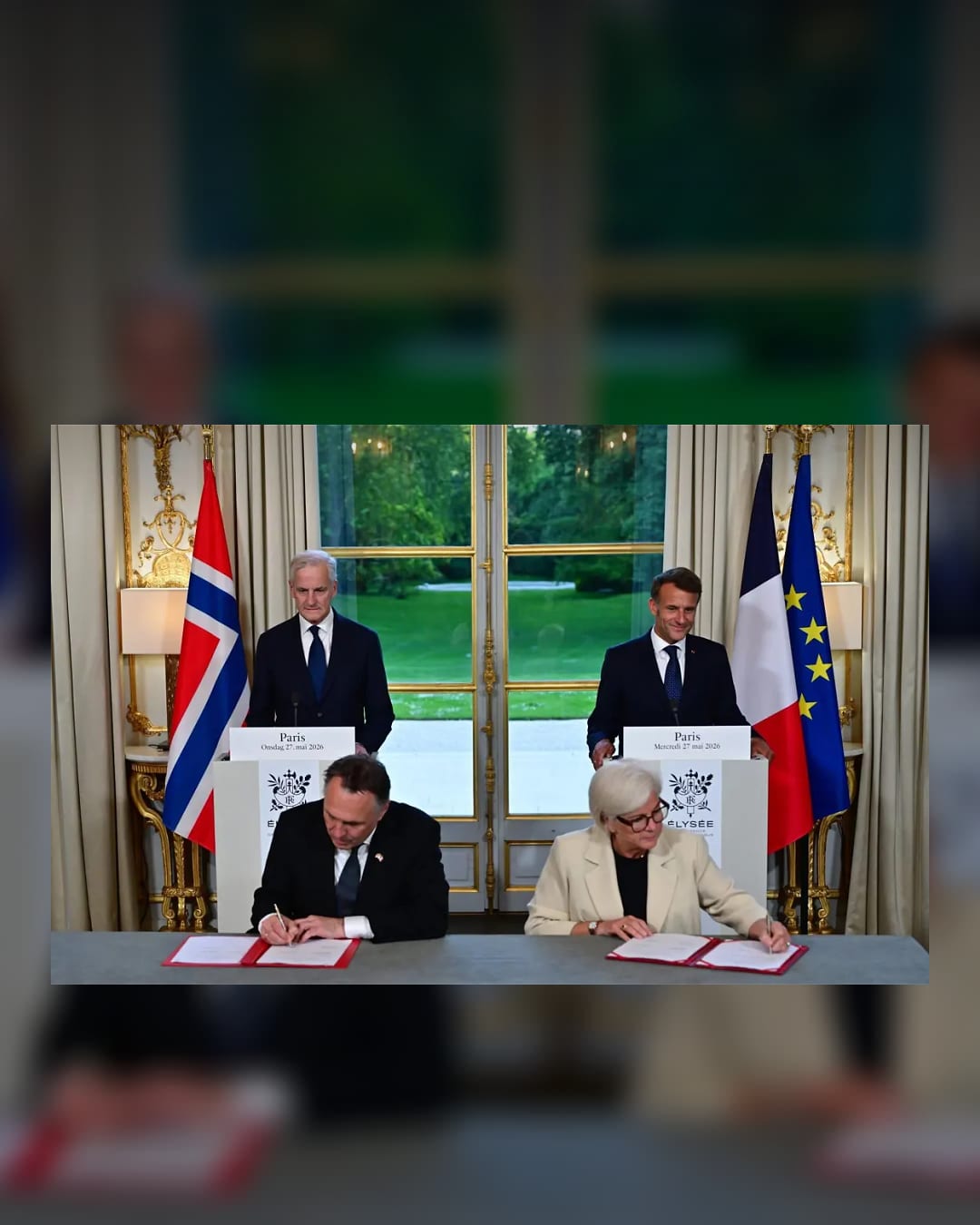
 Image: Christian Liewig / Office of the Prime Minister of Norway. The Narvik Agreement signing ceremony in Paris.
- Norway and France signed the Narvik Agreement in Paris on May 27, 2026.
- The agreement includes a mutual defence clause: each country commits to come to the other's aid, including military assistance, if needed.
- Norway is also joining talks on France's forward nuclear deterrence initiative, while saying no nuclear weapons will be placed on Norwegian soil in peacetime.
Norway and France have signed a new mutual defence agreement in Paris, giving Europe another clear sign that states close to Russia are adding extra security guarantees alongside NATO.
The agreement is called the Narvik Agreement. According to the Norwegian government, it was signed on May 27 by Norwegian Defence Minister Tore O. Sandvik and French Minister for the Armed Forces and Veterans Catherine Vautrin, with Prime Minister Jonas Gahr Store and President Emmanuel Macron present in Paris.
What happened
The official Norwegian government release says the two countries "commit to come to each other's aid should the need arise." In the detailed explanation, Oslo says the agreement includes military assistance and creates structures for planning, exercises, prepositioning of equipment and faster reinforcement.
That makes the viral shorthand partly right but too loose. This is a mutual defence agreement, not just a symbolic handshake. But the nuclear part is a separate deterrence track rather than a simple statement that France will automatically use nuclear weapons if Norway is attacked.
The nuclear part
Norway will participate, with nine other European countries, in a process connected to France's forward deterrence initiative. The Norwegian government says the talks will examine how French nuclear weapons can contribute to European security and deterrence.
Reuters, citing Prime Minister Store's comments to Norwegian agency NTB, described the shift as Norway coming under France's nuclear umbrella. Reuters also noted that, in practice, an attack on Norway could trigger a French nuclear response under the broader deterrence logic.
There are two important limits. Norway says its deterrence will continue to be provided by NATO, and the U.S. nuclear guarantee to Europe remains unchanged. Store also said Norway's nuclear policy is not changing: no nuclear weapons on Norwegian soil in peacetime, with arms control and non-proliferation still part of Oslo's position.
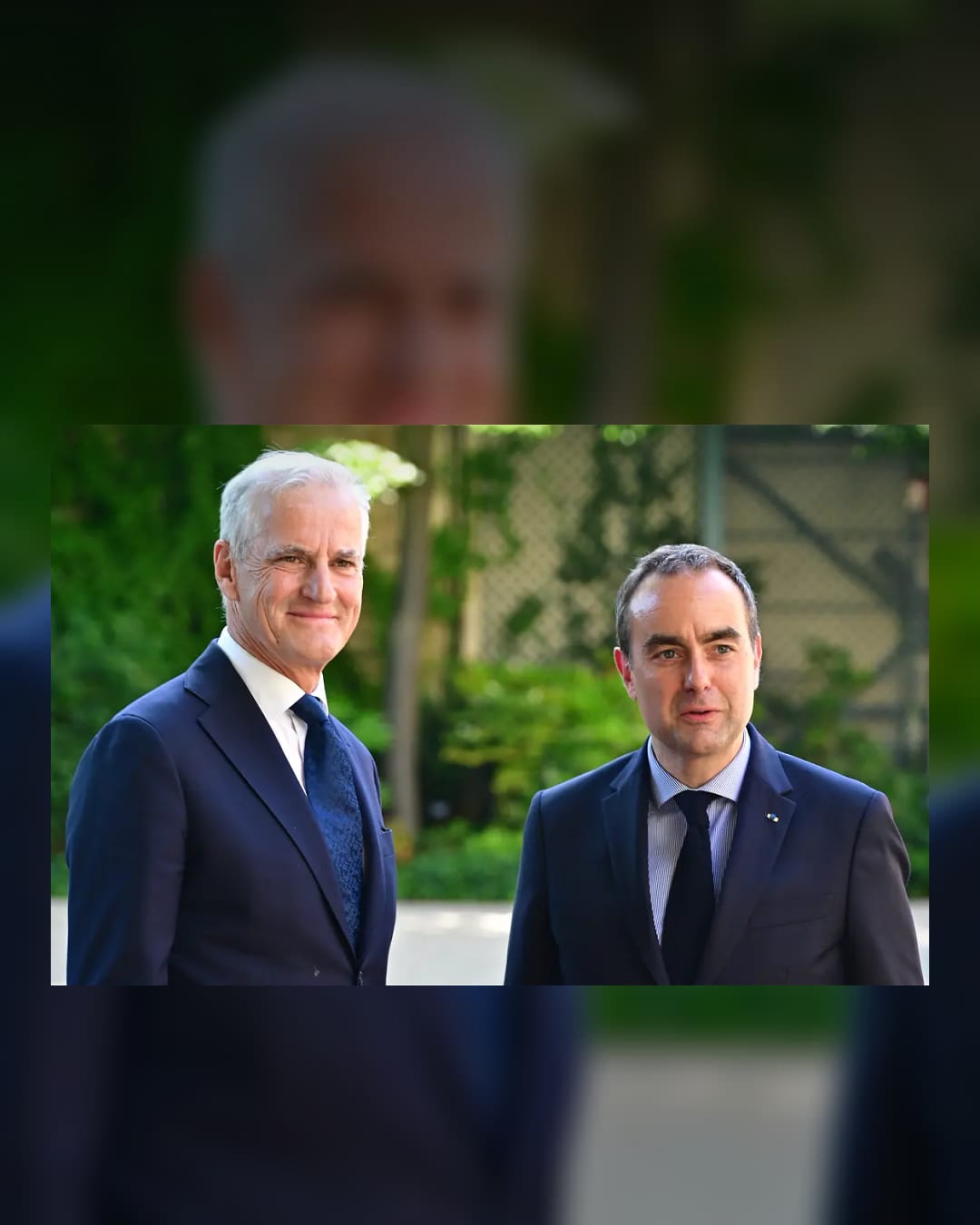 Image: Christian Liewig / Office of the Prime Minister of Norway. Jonas Gahr Store and Sebastien Lecornu at Matignon in Paris.
Why it matters
This is part of a wider European security reset. Norway says the agreement follows earlier defence deals with the United Kingdom and Germany, giving Oslo formalized ties with the three largest military powers in Western Europe.
The geography matters. Norway is a NATO member, shares an Arctic border with Russia, and is central to North Atlantic and High North security. France is also one of the European allies most active in Norway's northern waters. The agreement gives the relationship more structure in the areas that matter during a crisis: Arctic operations, air defence, maritime security, cyber, space and defence industry cooperation.
The timing also matters. Russia's war against Ukraine, nuclear rhetoric and pressure on Europe's security architecture have pushed European governments to reduce dependence on a single guarantee. Norway is not leaving NATO's framework. It is adding a French-European layer to it.
What is confirmed
Confirmed: Norway and France signed a mutual defence agreement in Paris. Confirmed: the agreement includes assistance, including military assistance, if needed. Confirmed: Norway is joining France's forward nuclear deterrence initiative alongside the UK, Germany, Poland, the Netherlands, Sweden, Denmark, Belgium and Greece.
Not confirmed: that French nuclear weapons will be deployed in Norway. The official Norwegian statement says the opposite for peacetime.
NoDechev rating: verified agreement, careful nuclear wording. The mutual defence pact is real, and Norway is joining France's nuclear deterrence process; the precise trigger and operational meaning of any nuclear response remain deterrence policy, not a published automatic-use clause.
Ready social post
Norway and France signed a mutual defence agreement in Paris, and Norway is joining France's forward nuclear deterrence initiative. Key caveat: Oslo says no nuclear weapons will be placed on Norwegian soil in peacetime.
Read next: NATO prepares for the Russia scenario it says it wants to prevent