

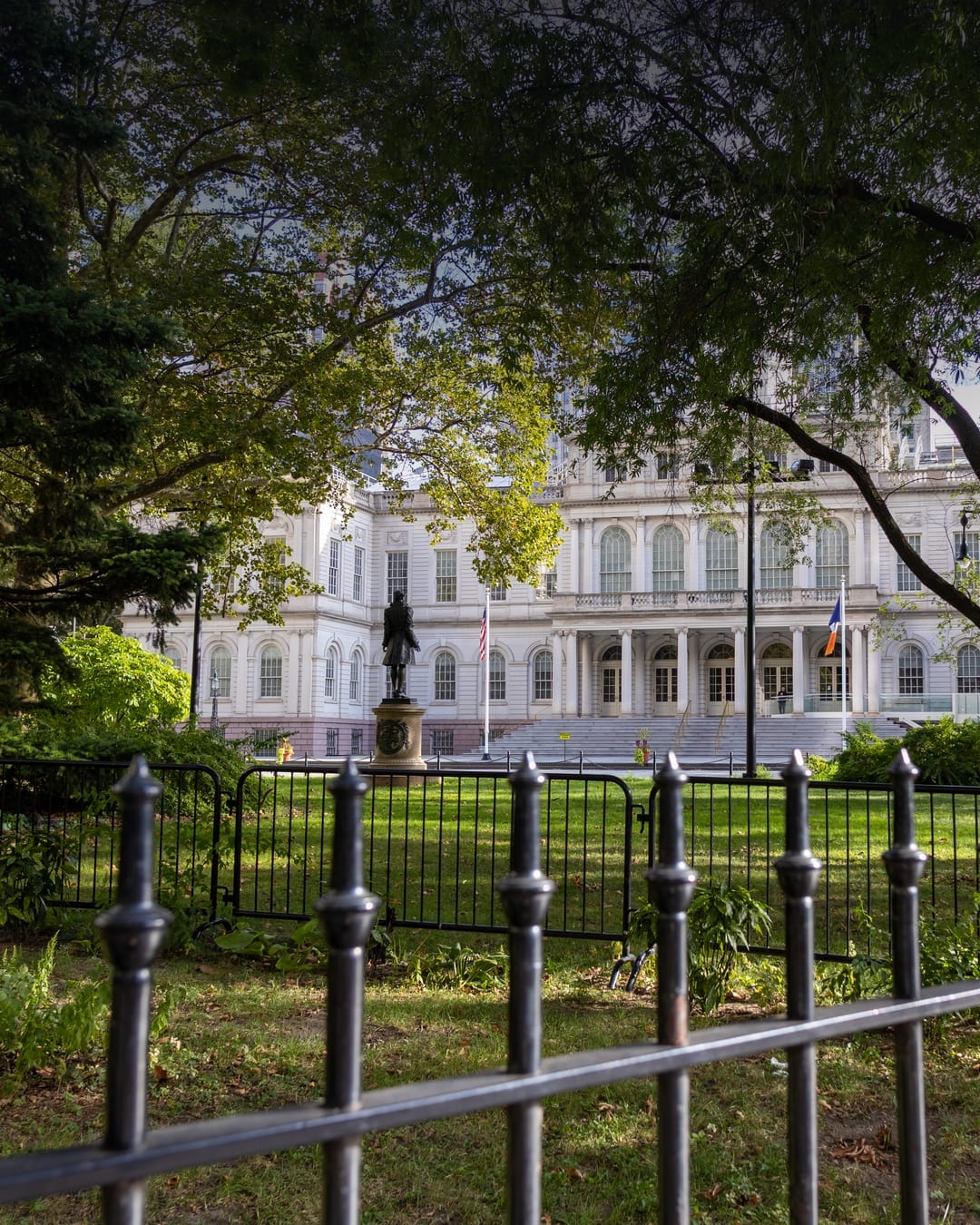
 Image: New York City Hall exterior, September 2025 -- Wikimedia Commons.
- NYC's May 12 executive-budget release lists $1.77 billion in gap-closing savings across FY2026 and FY2027.
- It also lists an additional $1.2 billion from systemic program changes and $1.64 billion in FY2027 pension-payment savings.
- Together, those figures equal about $4.61 billion, which supports the "over $4.5 billion" claim.
- The scope matters: watchdogs warn that some savings are short-term, state-authorized or implementation-dependent, not all ordinary efficiency improvements.
Mayor Zohran Mamdani's administration is now being credited online with projected savings of more than $4.5 billion for New York City. The number is not invented. It lines up with the figures in the city's executive-budget materials: $1.77 billion in agency savings, $1.2 billion in additional program savings and $1.64 billion from restructuring a portion of pension payments in fiscal year 2027.
But the wording needs discipline. Calling the whole $4.6 billion "efficiency improvements" makes the claim sound cleaner than the source documents. A large part is indeed framed as waste-cutting, procurement reform, lease consolidation, contract changes and better financial management. Another part comes from program reforms and pension-payment timing, which are fiscal moves rather than a simple discovery of wasted cash.
What happened
On May 12, 2026, the Mayor's Office released a $124.7 billion Fiscal Year 2027 Executive Budget and said the city had closed a budget gap that had been described as more than $12 billion earlier in the year. The administration said the budget was balanced without raising property taxes, slashing services or drawing down long-term reserves.
The savings claim comes from that budget package and the mayor's presentation. The official release says the Chief Savings Officer effort achieved $1.77 billion in gap-closing savings across FY2026 and FY2027. It then says the administration identified another $1.2 billion by addressing systemic inefficiencies in major programs, and that pension-payment restructuring would save $1.64 billion in FY2027 alone.
What the data says
The arithmetic is straightforward: $1.77 billion plus $1.2 billion plus $1.64 billion equals $4.61 billion. That is why the "over $4.5 billion" version of the claim is supportable when the categories are combined.
The city gave more detail in the mayor's budget transcript. It said agencies identified $1.47 billion in savings initiatives over two years plus more than $300 million in vacancy reductions. The administration broke those agency savings into procurement reform, technology modernization, space consolidation, overtime and unused-program reductions, revenue claiming and more accurate expense estimating.
 Image: Manhattan Municipal Building -- Wikimedia Commons. The building houses major city offices, including the Comptroller's office.
What is confirmed
It is confirmed from the Mayor's Office that the executive budget claims $1.77 billion in agency-level savings, $1.2 billion from broader program changes and $1.64 billion in pension-payment savings. It is also confirmed that the administration's Chief Savings Officer program required agencies to find 1.5 percent savings for FY2026 and 2.5 percent for FY2027.
It is confirmed from IBO's June 1 analysis that the city presented a balanced executive budget and that independent budget analysts were reviewing the planned revenue and savings areas while negotiations continued ahead of the June 30 fiscal-year deadline.
What needs scope
The biggest caveat is category creep. "Efficiency improvements" is a fair label for pieces like procurement reform, software-license savings, unused-space reductions and in-sourcing contracts. It is less precise for pension-payment restructuring, which lowers near-term required contributions by changing the payment schedule for unfunded accrued liabilities, subject to approval by city pension boards.
Watchdogs are also not treating the budget as risk-free. Comptroller Mark Levine said the executive budget improved from the preliminary plan and avoided raiding rainy-day reserves, but warned that it relies on one-time measures, short-term pension savings and strategies that need close monitoring. IBO separately said the city still faces large gaps starting in 2028, from $7.6 billion to $9.3 billion.
Why it matters
The politics are simple: Mamdani's supporters can point to a real budget document showing billions in projected savings while protecting major services. Critics can point to the same documents and argue that some of the savings are temporary, uncertain or pushed into future budget years.
The source-based read is therefore neither "fake" nor "miracle." NYC's own budget materials support a combined savings figure above $4.5 billion. The more accurate public wording is that the executive budget projects more than $4.5 billion from a mix of agency savings, program-efficiency changes and pension-payment restructuring.
What to watch next
The next test is implementation. Watch whether the City Council budget agreement preserves the same savings assumptions, whether pension boards approve the restructuring, whether CityFHEPS and special-education savings materialize, and whether the city can reduce projected out-year gaps without relying on repeated short-term fixes.
NoDechev rating: real number, broader than the slogan. The $4.5 billion-plus figure is supported by the executive-budget math, but not all of it is plain operational efficiency.
Also Read
For more on Mamdani's early mayoralty, read the worker-restitution brief.
Read the Mamdani restitution brief ->