

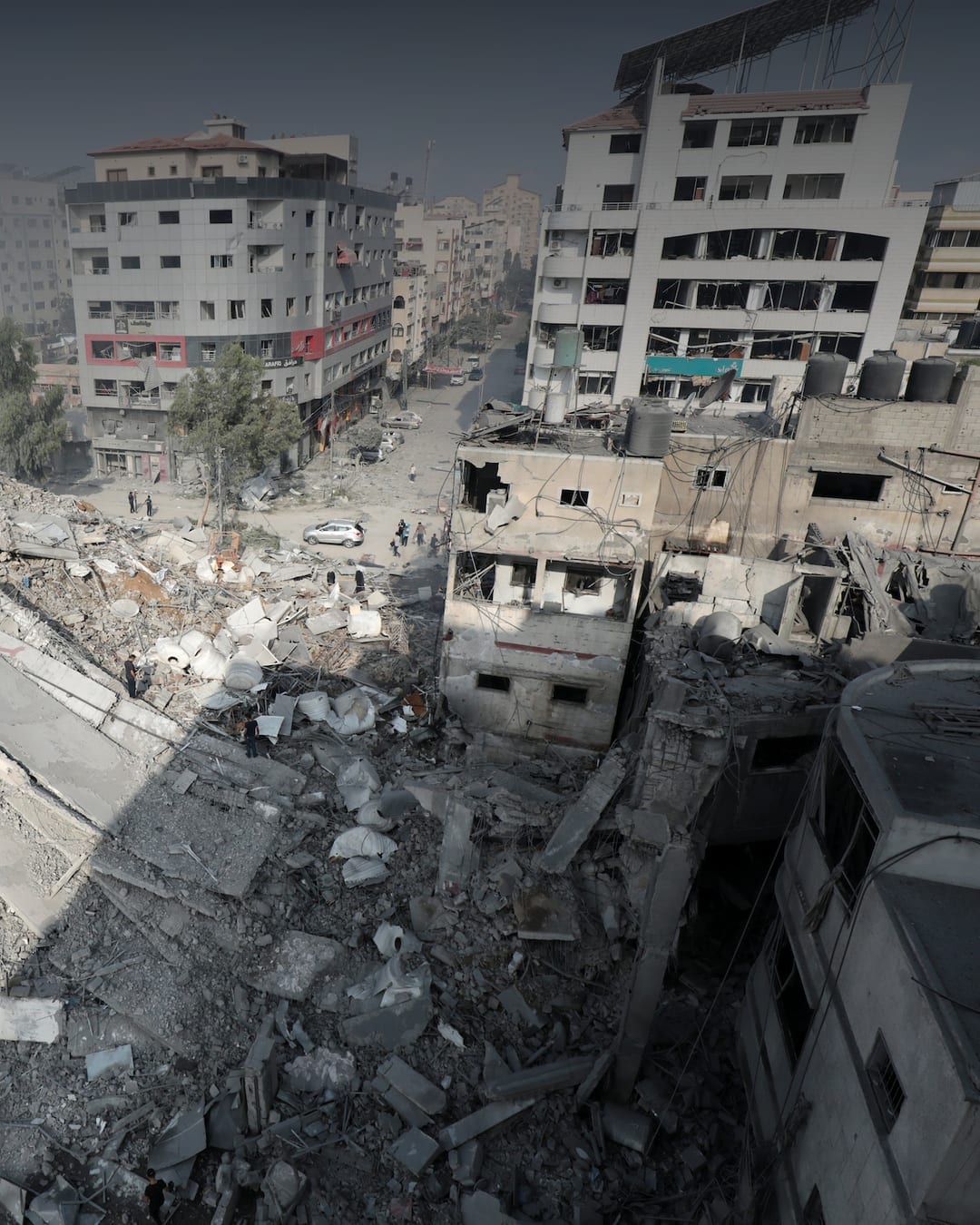
 Image: Damage in Gaza Strip during the October 2023 war period — Wikimedia Commons.
- Al Jazeera reports Egypt has launched urgent contacts to salvage the Gaza ceasefire after renewed Israeli attacks and displacement threats.
- Netanyahu has said he directed Israel's military to expand control of Gaza toward 70 percent, beyond the roughly 53 percent line tied to the October ceasefire.
- The clean status: the ceasefire is still described as fragile and under strain, not formally over.
Egypt has warned Israel that dangerous escalations in Gaza could undermine the ceasefire and push the strip back toward open war, according to Al Jazeera reporting published May 30.
The warning comes as Cairo tries to bring the negotiation track back under control after renewed Israeli strikes, Israeli statements about expanding military control, and renewed language around Palestinian "voluntary migration" out of Gaza.
What happened
Al Jazeera reported that Egypt has opened urgent diplomatic contacts to rescue the ceasefire and invited a senior Hamas delegation, led by chief negotiator Khalil al-Hayya, for talks in Cairo.
An Egyptian intelligence official told the outlet that Cairo was racing to arrange negotiations before the end of the week to prevent all-out war in Gaza. The report also said Egypt contacted U.S. officials to ask President Donald Trump to restrain Israeli Prime Minister Benjamin Netanyahu.
The immediate pressure point is not one event. It is the combination of renewed Israeli attacks, Netanyahu's stated plan to expand Israeli control in Gaza, and Israeli Defence Minister Israel Katz's public revival of a displacement framework that Israel describes as "voluntary migration."
What the data says
Al Jazeera cited at least 141 Palestinians killed in the last two weeks during intensified Israeli attacks. It also reported that at least 929 Palestinians have been killed in Israeli attacks since the October ceasefire took effect.
On May 28, Netanyahu said in remarks aired by Israeli media that Israel already controlled about 60 percent of Gaza and that his directive was to reach 70 percent. Guardian and Al Jazeera reporting both framed that as beyond the October ceasefire line, under which Israeli forces had withdrawn to a demarcation that left Israel with control of about 53 percent of the territory.
 Image: Gaza City skyline — Mr.david.w / Wikimedia Commons.
What is confirmed
It is confirmed that Egypt is treating the moment as a ceasefire-risk crisis. Al Jazeera's account describes Egyptian mediation with Hamas, Qatar, Turkiye and U.S. officials, plus Egyptian warnings against any attempt to push Palestinians toward Rafah or out of Gaza.
It is also confirmed that Israeli leaders have publicly discussed expanded control and migration plans. The Guardian reported Katz said large-scale Palestinian migration would proceed "at the right time and in the right manner," while Israeli officials use the term "voluntary migration."
What is not confirmed
There is no public confirmation that the ceasefire has formally collapsed. The stronger reading is that mediators believe the ceasefire is near a breaking point.
There is also no independently verified, complete public text showing exactly how the October ceasefire would handle Israel's proposed expansion of military control. That matters because both sides and mediators are likely to frame violations differently.
Why it matters
Egypt is not a bystander in Gaza diplomacy. Cairo controls the key border geography around Rafah, has been a core mediator with Qatar and the U.S., and strongly rejects any scenario that channels Gaza's population toward Egyptian territory.
If Israel moves from the ceasefire line toward 70 percent control, the political logic of the deal changes. Hamas can argue the truce has become cover for territorial expansion; Israel can argue it is responding to security threats; mediators are left trying to keep talks alive while facts on the ground shift.
What to watch next
The next useful signals are whether the Hamas delegation arrives in Cairo, whether the White House publicly echoes Egypt's concern, and whether Israel operationalizes the 70 percent directive or leaves it as political messaging.
For now, the clean read is this: Egypt is warning that Gaza's ceasefire is in danger because the military and displacement signals are moving faster than the diplomatic track.
NoDechev rating: credible warning, unstable status. The Egyptian mediation push and Israeli escalation signals are reported by major outlets; the ceasefire has not been publicly declared dead.
Also Read
The warning sits on top of a wider pattern of disputed ceasefire violations and targeted Israeli strikes in Gaza.
Read the ceasefire verification explainer