

Quick read
- Governor Gavin Newsom signed AB 1267 on September 30, 2026, the governor's office said.
- The bill repeals California provisions that allowed minors to marry or enter domestic partnerships with parental consent and court approval.
- The law sets the minimum age at 18; the available bill text does not state an urgency clause, so the effective-date point should be read with California's normal January 1 rule for regular-session statutes.
What happened
California Governor Gavin Newsom signed AB 1267, a bill that bans child marriage in the state by removing the legal route that had allowed people under 18 to marry with parental consent and court permission.
The governor's office announced the signing on September 30, saying Newsom signed the bill in his office with advocate Courtney Stodden, who has publicly described being allowed by her parents to marry actor Doug Hutchison when she was 16 and he was 50. Newsom called the measure "long overdue" and said California children are now safer.
The bill was authored by Assemblymember Gail Pellerin, a Democrat from Santa Cruz, and sponsored by Unchained At Last and the California Commission on the Status of Women and Girls.
What is confirmed
The core claim is confirmed: California has enacted a child marriage ban through AB 1267. The governor's announcement says the bill repeals provisions that allowed a minor to enter a marriage or domestic partnership with parental consent and sets the state's minimum marriage and domestic partnership age at 18.
The Legislature's own bill text matches that description. It says previous California law allowed an unmarried person under 18 to marry after obtaining a court order and written consent from a parent or guardian. AB 1267 repeals that authorization and prohibits a person under 18 from being issued a marriage license or establishing a domestic partnership.
The bill history shows the measure passed the Senate on August 19, 2026, with a 38-0 vote, and that the Assembly concurred in Senate amendments on August 26 with a 78-0 vote. It was enrolled and presented to the governor on September 3.
NBC Los Angeles independently reported the signing, identifying the measure as AB 1267 and noting that California had been one of the few states without a statutory minimum marriage age. The outlet also reported that, under the previous law, minors could marry with parental consent and court approval.
What is not confirmed
The exact county-level implementation guidance was not visible in the source set reviewed for this article. The signing is confirmed, and the statutory change is clear, but the practical rollout will depend on the state and county offices that issue licenses and record domestic partnerships.
The fetched governor's release and bill text also did not state an urgency clause. Under California's constitution, regular-session statutes generally take effect on January 1 after enactment unless a specific exception applies. That is why the careful framing is that California has signed/enacted the ban and set 18 as the minimum age, rather than saying every administrative effect began instantly on the signing date.
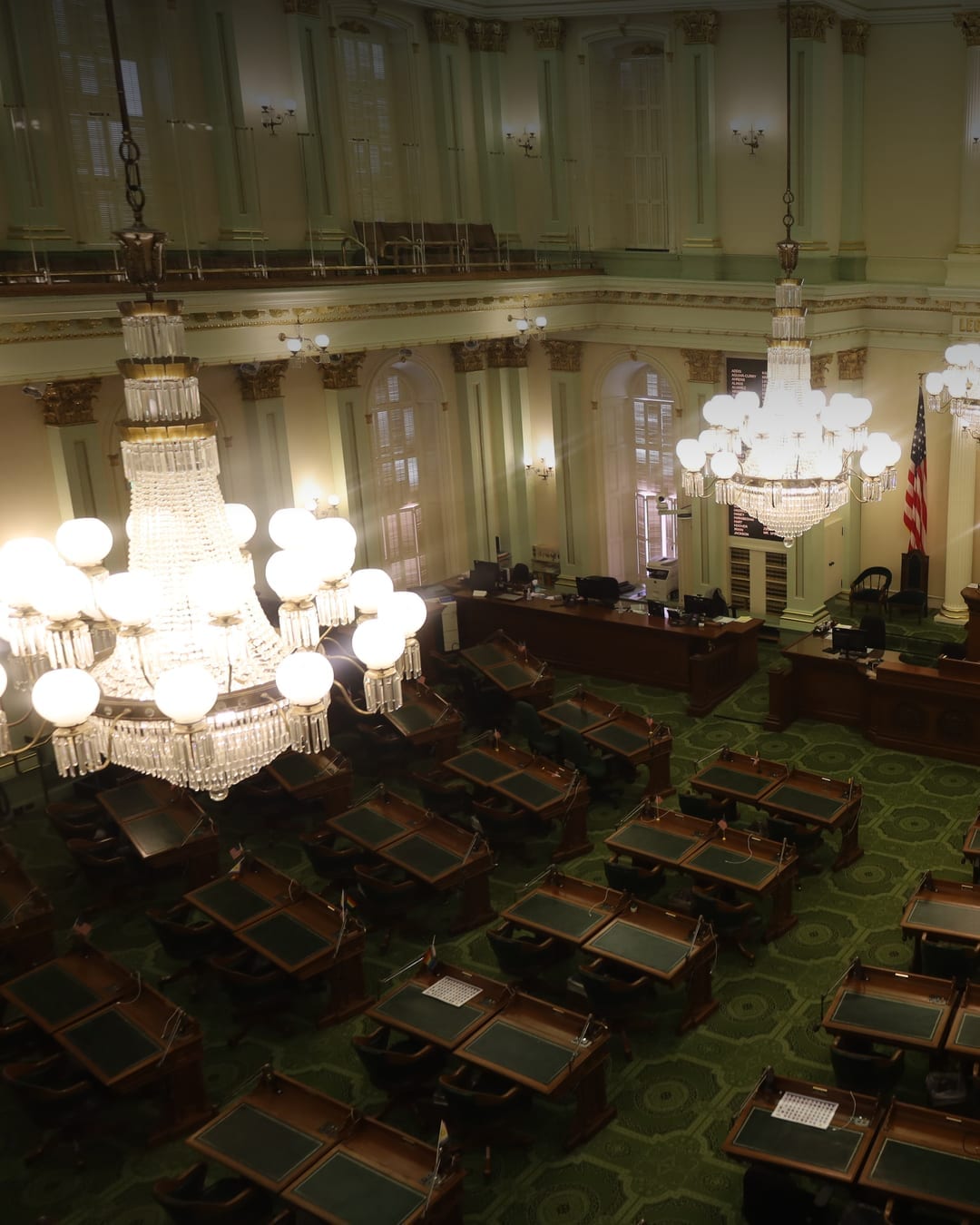
Image: California State Assembly chamber — Antony-22 / Wikimedia Commons, CC BY-SA 4.0.
Why it matters
California was a major remaining gap in the U.S. child marriage map. The governor's office said 17 states had completely banned child marriage without exception at the time Newsom signed AB 1267. Unchained At Last, one of the bill sponsors, says child marriage was legal in all 50 states as recently as 2017 and that California joined the ban list in 2026 alongside Oklahoma.
Advocates argue that parental consent and court-review systems can fail minors because children have fewer legal tools to leave home, retain counsel, seek protective orders or file for divorce without help from adults. Pellerin said survivors drove the effort by describing coercion, abuse and the difficulty of escaping a marriage as a minor.
NBC Los Angeles cited the nonprofit Global Hope 365 as saying about 35,000 marriages involving minors occurred in California between 2000 and 2021, mostly involving an underage girl marrying an adult man. That figure should be treated as an advocacy-group estimate, not a new government count, but it explains why the California bill drew sustained pressure.
What to watch next
The next practical step is implementation: how California's county clerks, courts and state record systems update forms, license procedures and domestic partnership rules before the effective date.
The national picture also remains uneven. Unchained At Last says child marriage remains legal in many U.S. states, either through minimum ages below 18 or through exceptions. California's move matters partly because it removes a large-state exception and gives advocates a new benchmark for campaigns in states that still allow under-18 marriage.
NoDechev rating
CONFIRMED with caveat. California officially signed AB 1267 to ban under-18 marriage and domestic partnership; the caveat is that the reviewed sources confirm enactment and substance, while the exact administrative implementation and effective-date mechanics require careful wording.